


 Google




In 2005, hedge-fund manager Joel Greenblatt published a deliberately provocative claim in "The Little Book That Beats the Market": a two-factor checklist, followed mechanically, had historically beaten the index by a wide margin. Twenty years later the Magic Formula remains one of the most studied — and most argued about — quantitative value strategies. Here is how it works and what to realistically expect.
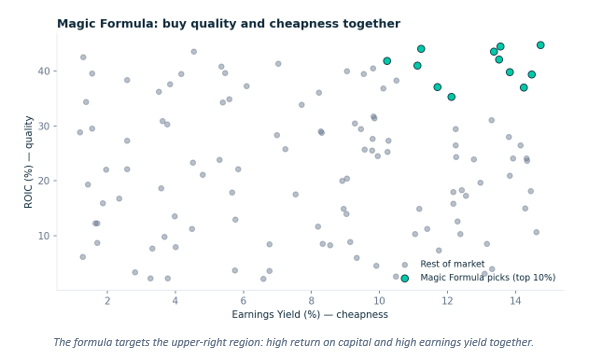
Two questions, one ranking
The formula scores every stock on exactly two things:
- Is the business good? Measured by return on capital — how much profit the company generates per unit of capital employed. Deepscope computes this in two variants, ROE and ROIC.
- Is the price cheap? Measured by earnings yield — roughly the inverse of the P/E ratio: how much profit you buy per unit of price.
Rank the whole market on each question, sum the two ranks, and buy a basket of the best combined scores. That's the entire strategy — no forecasts, no stories, no gut feel.
What the evidence says
Greenblatt's published backtests on US stocks showed roughly 30% annualized returns over 1988–2004 versus about 12% for the S&P 500 — figures from his own testing, which independent replications have generally found directionally right but smaller in magnitude, especially after transaction costs. More importantly, every serious study agrees on the pattern: the formula endures multi-year stretches of underperformance. Greenblatt himself argued this is why it keeps working — most people cannot stomach three losing years, so the discipline premium never gets arbitraged away.
Running it yourself vs. automating it
The strategy is simple; the bookkeeping is not. Computing return on capital and earnings yield consistently across an entire market, refreshing after every filing season, and re-ranking daily is exactly the kind of work software should do. Deepscope runs the Magic Formula across every Thai and US stock daily, in both ROE and ROIC variants, with each pick's price, P/E, dividend yield, and Quality/Timing Scores alongside — and the free Backtest tool lets you pressure-test the approach on 10+ years of history before committing money.
Caveats worth respecting
- Sector concentration: the formula periodically loads up on whatever industry is optically cheap — sometimes for good reason.
- Value traps: a high earnings yield can reflect earnings about to collapse; the formula cannot read news. Pairing picks with a quality and news-sentiment check reduces, but does not remove, this risk.
- Discipline is the strategy: cherry-picking from the list reintroduces exactly the human judgment the formula exists to remove.
Disclaimer: Deepscope is a licensed investment advisory company. All analysis on Deepscope is generated systematically from official exchange data. This article is educational content, not personalized investment advice. Past performance does not assure future results.