


 Google




The median Thai listed company trades at 0.80 times book value. The median US listed company trades at 1.32.
Put differently: more than half of Thailand's listed companies are priced below the accounting value of what they own. For anyone who grew up on value investing, that number is a magnet.
I want to take it seriously and then take it apart, because the same dataset that produces the 0.80 also explains why it is 0.80 — and the explanation is not "the market has not noticed".
The cheapness is real
Medians across every common stock on each market:
| Median | Thailand | United States |
|---|---|---|
| P/BV | 0.80 | 1.32 |
| P/E | 11.54 | 8.17 |
| Dividend yield | 2.83% | 0.00% |
| ROE | 5.89% | 3.28% |
| D/E | 0.24 | 0.20 |
Thai companies are not obviously more indebted, and the median return on equity is actually higher. On a static screen, this looks like a market trading at a discount without a matching deterioration in quality.
A note on the P/E line before anyone draws the wrong conclusion from it: the US median of 8.17 is lower than Thailand's, which sounds odd until you remember that the US listed universe contains thousands of micro-caps and recent listings with distorted or negative earnings. Median P/E across full universes is a noisy comparison. P/BV is the sturdier one, and it says what it says.
Now the part the screen does not show
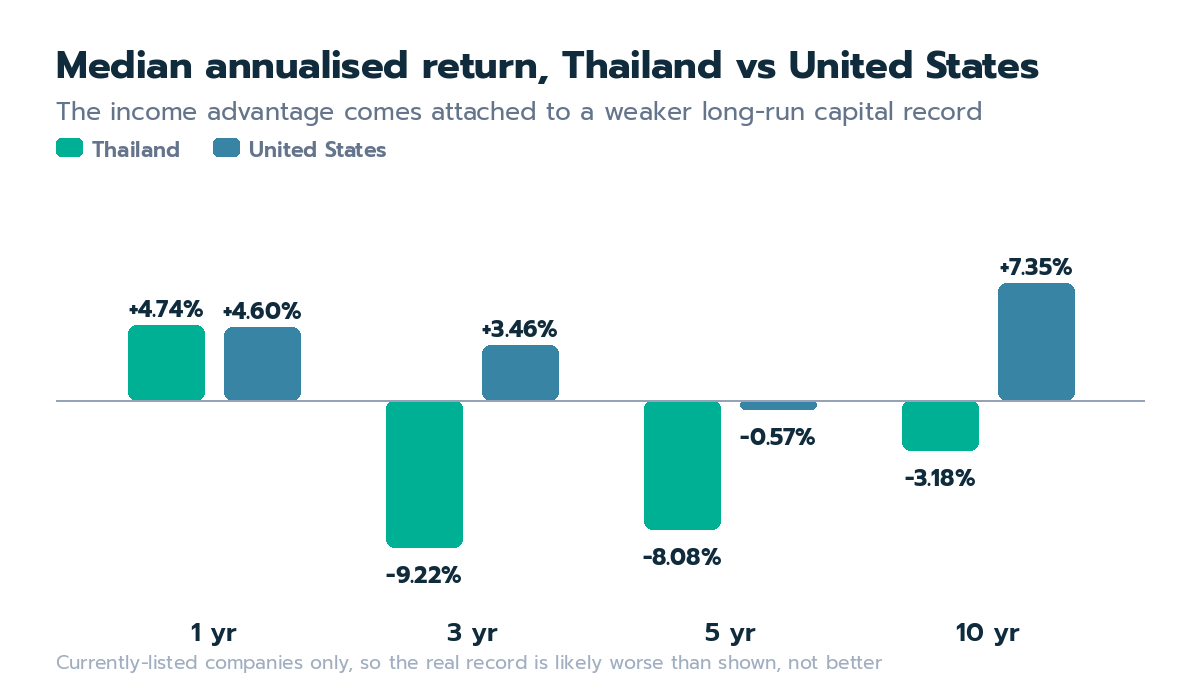
Here is what holding the median Thai stock actually did.
| Median annualised return | Thailand | United States |
|---|---|---|
| 1 year | +4.74% | +4.60% |
| 3 years | −9.22% | +3.46% |
| 5 years | −8.08% | −0.57% |
| 10 years | −3.18% | +7.35% |
Over ten years, the median Thai listed company compounded at −3.18% a year while the median US one compounded at +7.35%. Over five years, 29% of Thai listings delivered a positive average annual return, against 49% in the US.
So the 0.80 price-to-book is not a market oversight that has sat unexploited. It is the accumulated verdict of a decade in which the typical listed Thai company destroyed shareholder value in price terms.
A market prices assets below book when it doubts those assets will earn an adequate return. On this record, that doubt has been well founded on average.
Where "on average" stops being useful
Everything above is a median, and a median is a statement about the middle of a distribution, not about any company you might actually buy.
The same data says both of these things at once:
- The typical Thai listed company has been a poor long-run holding
- 197 Thai companies delivered a positive five-year annualised return, and 204 combine a dividend yield above 3% with a quality score of 60 or better
Two hundred companies is not a rounding error. It is a workable universe. The point of the median is not that Thailand is uninvestable — it is that the index-level cheapness is not the opportunity. Buying the market because the market looks cheap is buying the distribution that produced −3.18% a year.
The opportunity, if there is one, lives in separating the companies whose low multiple reflects a fixable problem from those whose low multiple reflects a permanent one. That is company-level work, and no screen does it for you.
Three checks before treating a low multiple as a signal
Is the book value real?
Price-to-book compares a market price to an accounting number. If the balance sheet carries land at historic cost, or goodwill from acquisitions that have not worked, or receivables that are unlikely to be collected, then "below book" is measuring against a figure that does not mean what it appears to.
Is the company earning anything on that book?
A business earning 3% on equity is worth less than its book value, and correctly so. Thailand's median ROE of 5.89% is not a level that justifies a premium. Screening for low P/BV without a return-on-equity floor reliably produces a portfolio of businesses that deserve their discount.
Has the discount been narrowing or widening?
A stock that has traded below book for a decade is telling you something different from one that fell below book last quarter. The first is a market with a settled opinion; the second is a market changing its mind. Only the second is a re-rating candidate.
What I would actually conclude
Thailand is genuinely cheap on assets and genuinely generous on income — 0.80 times book, 2.83% median yield, half the market yielding above 3%.
Thailand has also been a poor place to own the average listed company for ten years. Both statements come from the same dataset and neither cancels the other.
If you are here for income, the structural case is strong and the numbers in the Thailand vs US dividend comparison hold up under a quality filter. If you are here expecting a broad value re-rating because the index screens cheap, the ten-year record is the thing to explain away first — and "it is cheap" is not an explanation.
Look at the data yourself
The full list of every Thai listing with P/BV, P/E, ROE, dividend yield and quality score is at all Thai stocks, ordered by market cap and refreshed after every close. The same fields for the US market are at all US stocks if you want to run the comparison yourself rather than take mine.
This article is for education and general information only and is not personalised investment advice, and does not recommend any specific security. All figures are generated automatically from data disclosed by listed companies as at the date of publication and change over time. Return figures cover companies currently listed and therefore carry survivorship bias — delisted and failed companies are excluded, so the true historical record is likely worse than shown. Past performance is not indicative of future results. Investors should do their own research and assess their own risk tolerance before making any investment decision.